The modern customer expects answers instantly, on any channel, at any time. Traditional call centers, built around queues and manual processes, struggle to keep up. That is where the intelligent contact center comes in, a data-driven, AI-powered environment designed to deliver faster, more personalized, and more efficient customer service. By leveraging artificial intelligence in contact centers and implementing AI for ITSM, businesses can streamline operations, anticipate customer needs, and empower agents with real-time insights.
Today, cloud computing with AI allows call centers to scale effortlessly, providing flexible storage, enhanced security, and seamless access to customer data. By combining computer technology with AI, intelligent call centers can automate routine tasks, predict customer behavior, and optimize workflows. For companies looking to grow their audience, marketing with AI and digital marketing using AI strategies enable hyper-targeted campaigns and real-time personalization, making every customer interaction smarter and more effective. Meanwhile, financial AI applications help call centers analyze transaction patterns, detect fraud, and provide data-driven insights that improve revenue management and risk mitigation.
Together, these technologies create a connected ecosystem where customer service, business intelligence, and marketing efforts converge, allowing an intelligent call center to deliver unmatched experiences for customers, agents, and the business alike.
In this guide, you will learn what an intelligent call center is, how it works, and the concrete benefits it brings to customers, agents, and the business as a whole.
Top 10 Intelligent Call Center Solutions to Elevate Customer Service and Agent Performance
When choosing the right platform for an intelligent call center, businesses need software that combines AI capabilities, seamless omnichannel support, and actionable analytics. Here are the top 10 solutions that help organizations transform their contact centers into smart, efficient, and customer-focused operations.
1. Bright Pattern
Bright Patt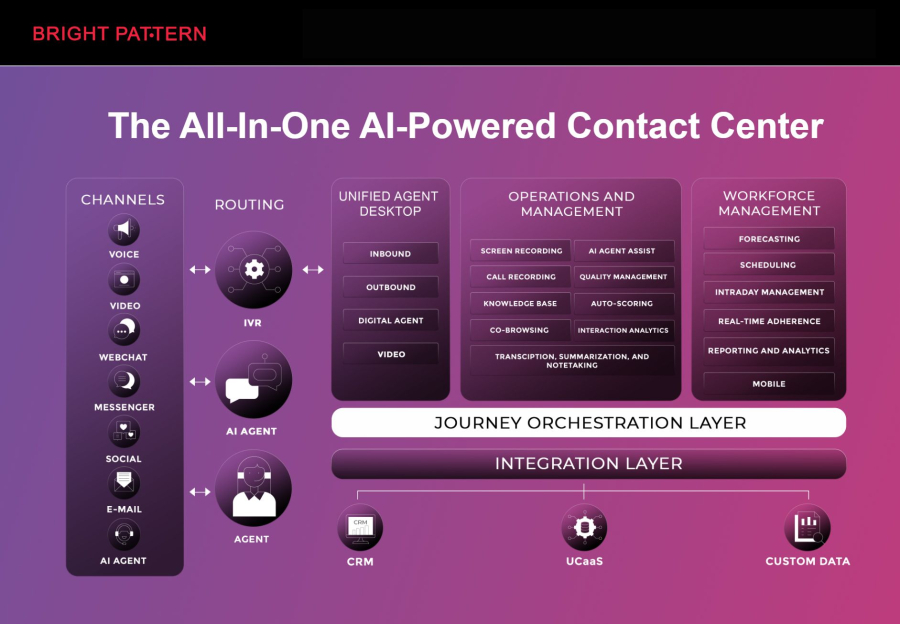 ern stands out as a leading intelligent call center platform designed to simplify customer engagement while delivering powerful AI-driven insights. Its cloud-native architecture allows organizations to scale effortlessly while providing personalized experiences across voice, chat, email, SMS, and social media channels.
Key features of Bright Pattern include:
- AI-powered routing: Directs customers to the right agent or resource based on context, history, and preferences.
- Omnichannel support: Enables seamless conversations across multiple channels without losing context.
- Advanced analytics and reporting: Offers real-time dashboards and actionable insights for performance optimization.
- Automation and AI integration: Automates routine tasks, improves resolution times, and enhances agent productivity.
- Flexible cloud deployment: Ensures reliability, security, and scalability for organizations of all sizes.
Bright Pattern’s platform is particularly effective for companies looking to combine AI for ITSM, marketing with AI, and financial AI applications in a single, integrated environment. Its intuitive interface and comprehensive features empower agents, improve customer satisfaction, and reduce operational costs.
2. Genesys
Genesys provides a robust AI-enabled contact center platform with strong analytics and workforce optimization capabilities. It supports omnichannel communication and predictive routing to enhance customer satisfaction.
3. Five9
Five9 offers a cloud contact center solution that integrates AI for intelligent routing, speech recognition, and real-time agent assistance. It helps businesses improve first-call resolution and streamline customer interactions.
4. NICE inContact
NICE inContact combines AI-driven automation with cloud flexibility, offering advanced analytics, omnichannel routing, and workforce management tools for improved efficiency.
5. Talkdesk
Talkdesk delivers an AI-powered cloud contact center with easy integrations, automation, and omnichannel support. Its AI tools help predict customer needs and optimize agent workflows.
6. Cisco Contact Center
Cisco provides a comprehensive AI-enabled contact center solution that integrates with existing IT infrastructure. It offers analytics, automation, and omnichannel capabilities for large enterprises.
7. Avaya OneCloud
Avaya OneCloud leverages AI to enhance customer engagement and agent productivity. Its platform supports cloud and hybrid deployments with omnichannel communication features.
8. 8x8 Contact Center
8x8 combines AI with cloud communications to offer seamless omnichannel support, real-time analytics, and automated workflows that improve customer experiences.
9. RingCentral Contact Center
RingCentral provides AI-assisted routing, performance analytics, and omnichannel integration for businesses seeking flexible, cloud-native contact center solutions.
10. Zendesk Talk
Zendesk Talk integrates AI tools for call routing, ticketing, and analytics, providing businesses with a simple, scalable solution to improve customer interactions and agent efficiency.
What Is an Intelligent Call Center?
An intelligent call center is a customer service operation that uses technologies like artificial intelligence, automation, analytics, and cloud communications to handle interactions more efficiently and effectively than traditional setups.
Instead of relying only on agents and static call routing rules, an intelligent call center uses data and AI to:
- Understand customer intent in real time.
- Route interactions based on skills, priorities, and context.
- Automate repetitive tasks and simple inquiries.
- Support agents with on-screen guidance and recommendations.
- Continuously improve performance with analytics and feedback loops.
The result is a more responsive, personalized experience for customers and a more focused, productive environment for agents.
Key Components of an Intelligent Call Center
An intelligent call center is not a single tool; it is a combination of capabilities that work together. The following components are common building blocks.
1. AI-Powered Virtual Assistants and Chatbots
AI assistants can handle many routine tasks that used to consume agent time, such as:
- Answering frequently asked questions.
- Providing order status or account balance information.
- Resetting passwords and guiding through simple processes.
- Collecting initial information before passing a case to a human agent.
These virtual agents can operate across channels — voice, web chat, in-app messaging, and more — delivering consistent, always-on support. When a human handoff is needed, they pass context so customers do not need to repeat themselves.
2. Intelligent Routing and Skills-Based Distribution
In an intelligent call center, calls and messages are routed usingdynamic rulesinformed by data, such as:
- Customer profile and previous interactions.
- Language, location, and time zone.
- Agent skills, experience, and current workload.
- Priority level based on customer value or issue severity.
Instead of sending customers to the next available agent, the system directs each interaction to thebest suited resource. This improves first contact resolution and shortens handle time.
3. Omnichannel Orchestration
An intelligent call center does not limit itself to voice calls. It unifies multiple channels, such as:
- Phone and VoIP.
- Email.
- Web chat and in-app messaging.
- Social media and messaging apps.
- SMS and text.
All of these channels are managed in a single interface, with a unified customer history. That means agents can see past interactions and context, regardless of the channel, and customers can move seamlessly from one touchpoint to another without losing continuity.
4. Advanced Analytics and Reporting
Data is at the heart of an intelligent call center. Analytics capabilities typically include:
- Real-time dashboards with service level, wait times, and queue health.
- Historical reports on volumes, handle time, and agent performance.
- Speech and text analytics to detect topics, sentiment, and compliance issues.
- Trend analysis to identify recurring problems and opportunities for automation.
These insights allow leaders to optimize staffing, refine routing rules, improve scripts, and invest in the areas with the greatest impact on customer experience.
5. AI for Agent Assistance
Intelligence is not just for customers; it also supports agents in real time. Common AI driven assist features include:
- Next best action suggestionsto guide agents on recommended steps.
- Knowledge recommendationsthat surface relevant articles as the conversation unfolds.
- Real-time transcriptionthat turns calls into text, making it easier to capture notes and follow up accurately.
- Automatic summarizationto generate structured call notes after an interaction.
These tools reduce cognitive load and allow agents to concentrate on empathy, problem solving, and relationship building.
6. Automation and Workflow Orchestration
Automation coordinates the flow of work before, during, and after customer interactions. Examples include:
- Automatically creating and updating tickets or cases in backend systems.
- Triggering follow up emails, surveys, or notifications.
- Escalating cases based on business rules and service level targets.
- Synchronizing customer data across CRM, billing, and support tools.
By automating repetitive steps, the call center operates more consistently and frees employees to focus on high value tasks.
Business Benefits of an Intelligent Call Center
When all these components come together, the impact can be dramatic. Below are the main business outcomes organizations typically pursue.
1. Higher Customer Satisfaction and Loyalty
Customers value speed, convenience, and personalization. An intelligent call center delivers on all three by:
- Reducing wait times through better routing and self service options.
- Providing 24/7 support via bots and automated workflows.
- Ensuring customers reach the right expert faster.
- Using history and preferences to offer more tailored experiences.
Over time, this leads to higher satisfaction scores and stronger loyalty, which directly supports revenue growth and customer lifetime value.
2. Lower Operational Costs
Intelligent call centers help organizations handle more interactions without a proportional increase in staff. Cost efficiencies come from:
- Deflecting simple tasks to self service channels and chatbots.
- Reducing average handle time through better routing and agent assistance.
- Minimizing rework and transfers by giving agents complete context.
- Using analytics to optimize staffing and forecasting.
These savings can then be reinvested in strategic initiatives, such as expanding service hours, training, or new digital experiences.
3. Increased Agent Productivity and Engagement
An intelligent environment does more than improve metrics; it also makes agents' jobs more rewarding. Key advantages for agents include:
- Less time on repetitive questions and data entry.
- More support from AI for research, recommendations, and note taking.
- Clearer performance insights and coaching opportunities.
- Greater ability to focus on complex cases that use their skills.
When agents feel empowered and supported by their tools, they are more engaged, which further improves the quality of customer interactions.
4. Better Decision Making with Data
Because every interaction is captured and analyzed, decision makers gain a rich view of customer needs and operational performance. This supports smarter decisions on:
- Product improvements based on recurring support issues.
- Policy changes to prevent friction and confusion.
- Training and knowledge investments aligned to real gaps.
- Strategic shifts in channel mix and service offerings.
Instead of relying on gut feelings, leaders can test hypotheses, measure impact, and continuously refine their approach.
From Traditional to Intelligent: A Side by Side View
The following table highlights the shift from a traditional call center model to an intelligent, AI driven one.
|
Aspect |
Traditional Call Center |
Intelligent Call Center |
|
Routing |
Static queues, first available agent. |
Dynamic skills based routing using customer data and context. |
|
Self service |
Basic IVR menus, limited options. |
AI chatbots and virtual agents handling a wide range of tasks. |
|
Channels |
Primarily voice, limited integration. |
Omnichannel with unified history and consistent experiences. |
|
Agent tools |
Manual note taking and searching. |
Real-time guidance, automatic transcription, and summaries. |
|
Analytics |
Basic reports, mainly historical. |
Real-time dashboards plus speech and text analytics. |
|
Scalability |
Scaling requires more agents. |
Automation and AI absorb volume growth efficiently. |
Intelligent Call Center Use Cases
Intelligent capabilities can be applied across many industries and scenarios. Here are a few practical examples.
Proactive Customer Support
Analytics can identify customers at risk of churn or those experiencing repeated issues. The call center can then reach out proactively with solutions or offers, turning a potential problem into a positive experience.
Smart Collections and Billing
In finance and utilities, intelligent routing and AI can prioritize high impact cases, personalize reminders, and recommend the best communication method and timing to improve payment rates while maintaining a respectful customer experience.
Technical Support and Troubleshooting
AI assistants can collect device details, logs, and basic diagnostic information before an agent joins, significantly shortening resolution time. Knowledge suggestions based on real cases help agents handle complex technical issues more efficiently.
Sales and Upsell Opportunities
By analyzing intent and behavior during service interactions, the intelligent call center can recommend relevant products or upgrades at the right moment, supporting revenue generation without compromising on service quality.
Steps to Building an Intelligent Call Center
Organizations do not need to transform everything at once. A phased approach allows you to capture benefits quickly while managing change effectively.
1. Clarify Your Objectives
Start with the business outcomes you want to achieve. Common goals include:
- Reducing average wait time or abandonment rates.
- Improving customer satisfaction or net promoter scores.
- Lowering cost per contact.
- Enhancing agent productivity and experience.
Clear goals make it easier to prioritize capabilities and measure impact.
2. Map Current Journeys and Pain Points
Review how customers currently interact with your call center. Identify where they experience friction, such as:
- Long or confusing IVR menus.
- Repeated transfers between departments.
- Inconsistent answers across channels.
- Limited visibility into order or case status.
These pain points highlight where intelligence and automation will make the biggest difference.
3. Prioritize High Impact Capabilities
Based on your goals and pain points, determine which features to implement first. For many organizations, quick wins come from:
- Deploying an AI chatbot for common questions.
- Improving routing with skills based rules.
- Introducing real-time dashboards and alerts.
- Automating after call work and ticket creation.
These initiatives often deliver measurable improvements within a short period.
4. Integrate with Existing Systems
To unlock the full value of an intelligent call center, it should be connected to systems like CRM, order management, billing, and knowledge bases. This ensures that:
- Agents see a complete view of the customer.
- Data stays consistent across departments.
- Automation can act on real time information.
Thoughtful integration avoids data silos and delivers a seamless experience for both customers and employees.
5. Invest in Training and Change Management
Technology is only part of the story. Agents and supervisors need training to get the most out of new tools. Effective enablement includes:
- Hands on workshops for using AI assist features.
- Clear guidelines on when to use automation and when to escalate.
- Coaching sessions based on new analytics insights.
- Feedback loops so teams can suggest improvements.
When agents see how intelligent tools make their work easier and more impactful, adoption naturally increases.
Measuring the Impact of Intelligence
To track success, it is important to monitor a balanced set of metrics that reflect both efficiency and experience. Useful measures include:
- Customer experience: satisfaction scores, first contact resolution, and customer effort.
- Operational efficiency: average handle time, cost per contact, and self service containment rates.
- Agent performance: adherence, productivity, and quality monitoring results.
- Business outcomes: retention, upsell rates, and issue reduction due to proactive support.
Regularly reviewing these metrics helps you fine tune the intelligent features and keep them aligned with strategic priorities.
The Future of Intelligent Call Centers
Intelligent call centers will continue to evolve as AI, automation, and analytics mature. Emerging trends include:
- More accurate and natural language understanding for complex conversations.
- Deeper personalization based on behavior, preferences, and context.
- Greater use of predictive models to anticipate needs and automate decisions.
- Closer integration between service, sales, and marketing interactions.
Organizations that invest early and iterate over time will be well positioned to deliver standout customer experiences and operate more efficiently than competitors.
Conclusion: Turning Your Call Center into a Strategic Advantage
An intelligent call center turns a traditional cost center into a powerful engine for customer satisfaction, loyalty, and growth. By combining AI, automation, omnichannel orchestration, and data driven insights, you can:
- Serve customers faster and more personally.
- Empower agents with modern, supportive tools.
- Reduce operating costs while improving quality.
- Make smarter decisions based on real time data.
Step by step, these improvements transform your call center into a strategic asset that supports long term success.
